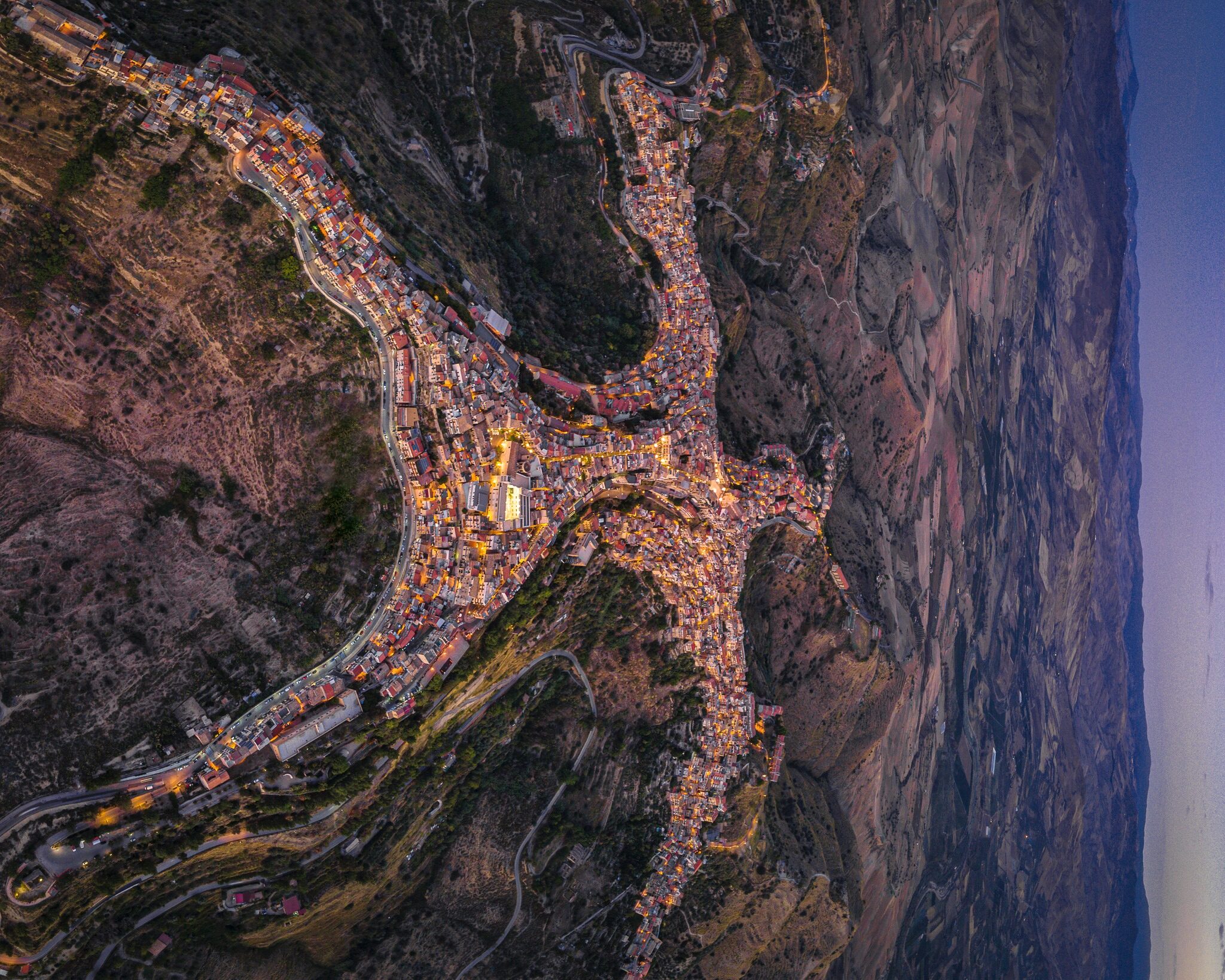
Caltabellotta, where time came to rest on the wind

You climb to Caltabellotta the way you climb towards a memory: slowly, bend after bend, leaving the sea behind you.
From Sciacca the road breaks away from the coast and begins to clamber up through the olive groves. The trees are old and twisted, their trunks split like a farmer’s hands, and in November they still carry the scent of the harvest just gathered. Dry-stone walls run alongside the tarmac, broken here and there by a rusted gate, by a dog that lifts its head and then lowers it again, by a farmhouse whose windows have been shut for who knows how many winters. The sky widens. Behind you, the sea thins to a blade. Barely twenty kilometres, and it feels like a hundred. And a hundred years.
Then, at a bend, the mountain opens and you see it.
The Pizzo. A tooth of pale rock driven into the sky, huge and solitary, as if it had fallen there from another world. At its feet the village huddles in an embrace of stone: low houses, tiled roofs, walls the colour of baked bread. The maps say nine hundred and forty-nine metres. But up there nobody counts them. Up there what counts are the clouds, which pass so close to the rock they almost graze it, and the light, which changes every half hour like an old man’s mood.
First of all you have to speak of the wind, because in Caltabellotta the wind is master of the house.
In November it comes from the south, from the African sea, carrying a warmth that no longer belongs to the season: a late, stubborn summer that refuses to leave. It climbs the slopes, crosses the olive groves and soaks up their scent, green and bitter, the scent olives have when they have just been torn from the branch, the one that stays on your fingers for hours. Then it enters the village.
And in the village it finds no one.
Or almost no one. It finds chairs outside the bars, empty, turned towards the street as if waiting for someone who never comes. It finds half-closed shutters, wooden doors, a stone stairway that drops between two walls and loses itself in the light. It finds a wrought-iron gate and sets it trembling, with a thin sound that bounces between the façades. It is the only noise. No car, no voice, no radio from an open window. Only the wind, and the olive trees the wind carries with it.
Whoever arrives from the city, with its rhythm still clinging to them, feels it first as an emptiness. The body looks for the noise it is used to and cannot find it. Then, little by little, something loosens. Your step slows by itself, your breathing lengthens. And you realise that time here has not stopped: it has simply stopped running. It has sat down, like an old man on his doorstep, and watches the day go by.
Everything in Caltabellotta invites you to climb.
The alleys are not streets but cracks between the houses. The walls are made of the same stone as the mountain, and through them the mountain goes on breathing: they are covered in grey, yellow and orange lichen, like a skin marked by the seasons. The balcony railings are curls of hand-wrought iron, and the steps are smooth, worn hollow in the middle by generations of feet. And at every turn, suddenly, the void opens between two walls. The valley falling away in terraces, the hills rolling to the horizon and, far below, the sea: a strip of silver lit by the low sun, so distant it looks like a mirage. You can see the sea from almost every corner of the village, but always sideways, always by surprise, like someone watching you in secret.
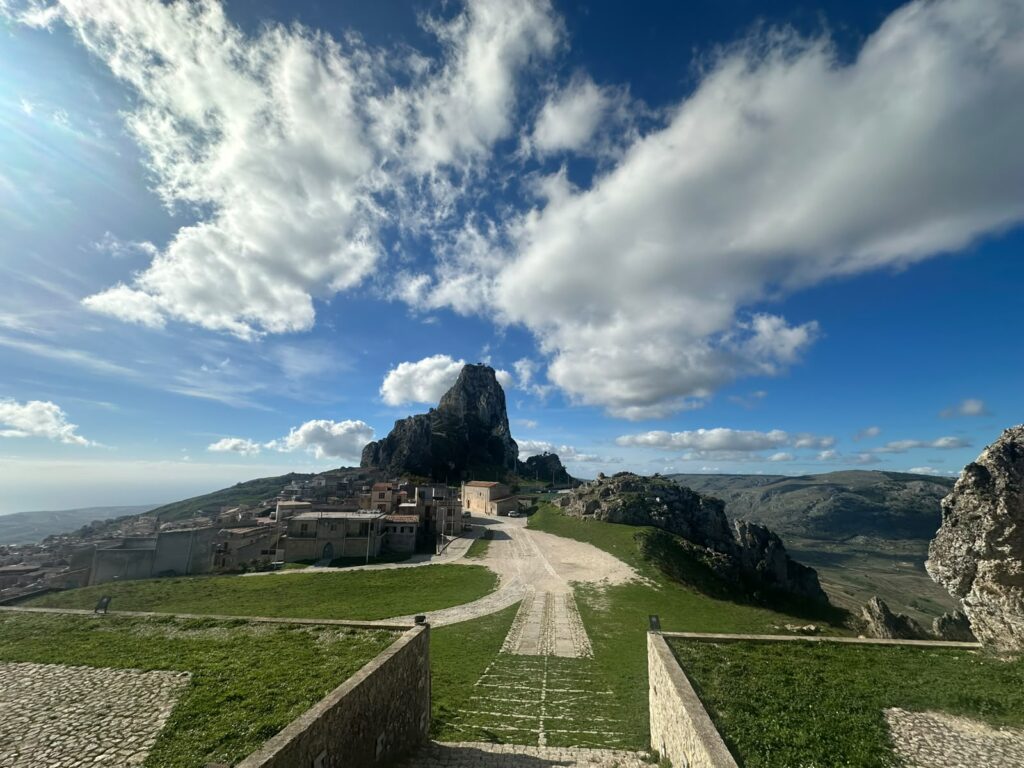
Then the alleys end, and you find yourself before the great esplanade of the Matrice.
No photograph truly tells it. It is a vast expanse of grass and cobblestones, open to the sky like an altar, suspended between the last houses and the precipice. The stones of the paving trace stripes and fans that draw your eye upwards. And up there is the Pizzo, showing itself here in all its bulk: a cathedral of rock carved by wind and rain, with a tuft of green on top like a plume. In November the grass has come back to life after the first rains, and that bright green against the white stone and the fierce blue of the sky has something unreal about it, almost northern, something you would never expect in Sicily.
At the edge of the esplanade stands a small, almost shy church: San Salvatore. It is all bare stone, with a gabled bell-cote holding a single bell. But its doorway is embroidery: a pointed arch framed by carved zig-zag mouldings, the kind the Norman masters left behind like a signature. In front of it, on the cobbles, a little red car is parked. Neither the church nor the car seems to find their closeness strange.
A little higher, crouching beneath the walls of the Pizzo, is the Chiesa Madre, dedicated to Maria Santissima Assunta. The Normans wanted it low and massive, with thick walls, because up there the wind forgives nothing. It has stood there for almost a thousand years, pressed against the rock like an animal sheltering from a storm.
At this point you have to stop and remember where you are.
This crag has watched three thousand years go by. Before it even had a name, the Sicani, the oldest people of the island, carved their tombs into the soft stone: small dark chambers you can still see, like closed eyes in the rock, beside the cave church of the Pietà. Here stood Triocala, which the ancients called impregnable, fertile and rich in water. In 99 BC rebel slaves barricaded themselves inside, and the Romans had to take it by storm. Then came the Arabs, who called it Qal’at al-ballut, the fortress of the oaks. The name has remained, worn smooth by the centuries like the stones of the paving.
And then there is that summer day. On 31 August 1302, at the foot of the castle that towers over the village, Frederick III of Aragon and Charles of Valois signed the peace that ended twenty years of the War of the Vespers. Sicily remained with the Aragonese. Ever since, this mountain village has carried an enormous word on its shoulders, peace, and it carries it with the dignity of someone wearing a coat several sizes too big.
You climb further, up a stairway cut into the rock, to what remains of the Castle of Count Luna, which some still call the castle of Queen Sibylla. There is little left: a double pointed-arch doorway, a stretch of wall, the foundations of a few rooms. But you do not climb this far for the ruins. You climb for what you can see. Up there the world opens in a full circle: the Sicani Mountains rolling over one another like frozen waves, the valleys of the interior, the coast of Sciacca, and the sea, whole at last, stretching towards Africa. The wind is stronger, it fills your ears, it carries your words away before you have even spoken them. And perhaps that is as it should be. Some places are not meant to be commented on.
At the other end of the village, on the other crag, is the Hermitage of San Pellegrino. The church, with its façade of 1721, rests above two caves, one on top of the other. In the first lived the saint. In the second, they say, the dragon.
The legend tells of a beast that devoured the children of Triocala, until Saint Peter sent Pellegrino to bring the Gospel to the Sicani. The saint faced the dragon and defeated it. At sunset, when the sun sinks towards the sea and sets the limestone ablaze with red, the story stops sounding like a fairy tale. Shadows stretch inside the caves, the wind slips between the rocks with a low sound, almost a breath, and you find yourself glancing over your shoulder.
We were speaking of olive trees.
That scent the wind carries through the streets is Caltabellotta’s wealth. Here they make an oil famous throughout Sicily, from a variety whose name sounds like a caress: Biancolilla. It tastes of cut grass and almonds, and ends with a peppery bitterness that scratches your throat and reminds you it is alive. November is the month of the olive mills. If you find one open, go in. New oil, green and cloudy, poured over a slice of still-warm bread, is one of those things that justify a journey all on their own.
Bread here is still kneaded from twice-milled durum wheat semolina, following the family recipe. The shepherds make sheep’s-milk ricotta, and someone, if they take a liking to you, will still offer it to you warm and trembling, with a drizzle of honey. And then there is macco di fave, the dish of memory: dried broad beans cooked for hours until they turn to cream, with chicory, cabbage, wild fennel, a spoonful of ricotta and a swirl of raw oil. Poor food, peasant food, almost without meat.
And yet perhaps the village’s secret lies precisely in that dish. In 2025 researchers from the universities of Palermo and Sassari identified Caltabellotta and the Sicani Mountains as a possible emerging Blue Zone, one of the rare places in the world where people live longest. Among those born here in the first quarter of the twentieth century, almost nine in a hundred lived past ninety. The scientists speak of diet, clean air, work in the fields, strong bonds between people.
I would add slowness. The slowness you feel in the alleys in November, when the only sound is the wind and no one, truly no one, is in a hurry to go anywhere.
You reach Caltabellotta by climbing up from Sciacca: some twenty kilometres of hairpin bends, a little over half an hour by car. From Palermo it takes about two hours, and Palermo airport is the nearest; Trapani Birgi is the alternative. If you don’t drive, you can rely on the Autolinee Lumia buses, which link the village to Sciacca in under half an hour and to Palermo with a few runs a day: check the timetables in advance, especially on public holidays. A car is still the best way to explore the surroundings too. Leave it in the car parks at the entrance to the village and continue on foot, because the old town is a tangle of alleys and stairways.
The full walk, from the square up to the castle and the hermitage, is three or four kilometres, almost all of it uphill or downhill. You will need shoes with good soles: you walk on cobblestones and, towards the castle and the hermitage, on paths of earth and rock. The castle ruins are open and free, while the hermitage and its caves open at irregular hours. Even in summer, bring a windproof jacket: at almost a thousand metres the wind is at home, and evenings turn cool quickly. For the sunset, climb to the Matrice esplanade or the castle, which both face the sea.
The best seasons for walking are spring and autumn. In November the air is clear and the village is all yours, but many places shorten their opening hours: it is best to phone before turning up for lunch. At Christmas Caltabellotta becomes the “Città Presepe”, the Nativity Town: its living nativity, the first in Sicily to be staged inside a village, fills the alleys and caves, usually on 26 and 27 December and 4 and 5 January. Entry is limited and must be booked through Le Vie dei Tesori, with shuttle buses running from the car parks. In spring, between late March and April, the women of the village organise the Festa di li Fimmini, a procession commemorating the “miracle of the rain” of 1957. And when the new oil fills the mills, the Olio Folk Fest celebrates Biancolilla, on dates that change every year.
Before you leave, taste everything: the oil, the ricotta, the bread, the macco. And if you still have time, head down to the spa and harbour of Sciacca, or push further inland, through the Sicani Mountains, as far as Sambuca di Sicilia.
When you set off again and the road begins its descent towards the sea, you look back just once. The Pizzo is still there, white against the sky. The south wind keeps passing through the olive trees, warm and stubborn. And you know, with a certainty that needs no proof, that up there among those stones time is still in no hurry.
And that sooner or later, you will have to return.