



Discover a lesser-known side of Sicily, where contemporary art meets the sea, the mountains and the small villages of the province of Messina. This road trip features scenic stops, extraordinary artworks and practical advice for planning a different kind of day out.
There are places in Sicily where the landscape itself seems like a work of art. The light over the Tyrrhenian Sea, the outlines of the Nebrodi Mountains, the roads crossing silent countryside and the villages perched on hillsides create scenery that needs no embellishment. Yet it was precisely in this setting that someone imagined art as a way to tell the story of a Sicily far removed from the best-known tourist routes.
This is how Fiumara d’Arte came into being: one of Italy’s most original open-air contemporary sculpture parks, a cultural itinerary through the Halaesa Valley area, in the province of Messina, between the Tyrrhenian coast and the inland hills. Here, enormous blue frames, abstract forms, a labyrinth, colourful ceramic works and a monumental pyramid turn a journey into an experience that brings together art, nature, architecture and the discovery of the local area.
This is not a traditional museum with galleries, ticket offices and a prescribed route. The artworks are spread across different locations, often far from inhabited centres. To find them, visitors must travel along provincial roads, climb into the hills, stop to admire the sea and learn to see the landscape from a new perspective.
Above all, Fiumara d’Arte is an invitation to slow down. It is not enough to reach a sculpture, take a photograph and move on. It is worth understanding the story behind each work, observing its relationship with the surrounding landscape and spending time in the villages that provide its setting.
This guide presents an itinerary through some of the most significant works of Fiumara d’Arte, with advice on planning your visit, suggestions for families and ideas for turning the excursion into a weekend of contemporary art, Sicilian villages and local food.
What Is Fiumara d’Arte and Why Is It So Special?
Fiumara d’Arte is a contemporary art project created through the vision of Sicilian patron Antonio Presti. Its story began in 1982, following the death of Presti’s father, when he decided to commission a commemorative work from sculptor Pietro Consagra. The original idea was to create a sculpture near the mouth of the Tusa River, a place associated with the patron’s personal memories.
This private gesture gradually developed into a much broader vision: creating an open-air museum accessible to the public and bringing contemporary art to a region that rarely occupied centre stage on Italy’s best-known cultural itineraries.
Consagra’s work, entitled La materia poteva non esserci (Matter Could Have Not Existed), was inaugurated in 1986 and became the starting point for a project that would involve numerous artists. In the years that followed, environmental installations, monumental sculptures and artistic interventions were created to engage with the distinctive features of the landscape.
The history of the park has not been straightforward. The project has faced legal disputes and difficulties concerning the location and protection of the artworks. Over time, the struggle to secure recognition of its public value helped make Fiumara d’Arte an important case study in the relationship between art, territory and public institutions.
Today, Fiumara d’Arte is associated with the activities of the Antonio Presti Foundation and the municipalities in the surrounding area, including Tusa, Motta d’Affermo, Castel di Lucio, Pettineo, Reitano and Mistretta.
Its importance lies in more than the sheer size of its sculptures. What makes the project truly distinctive is that the artworks are not isolated from the world around them. They are part of the landscape, changing the way it is perceived while themselves being transformed by light, the seasons and the visitor’s viewpoint.
A blue frame can become a window onto the Tyrrhenian Sea; a geometric structure can suggest a threshold between earth and sky; a labyrinth can evoke an inward journey. In this setting, art does not necessarily need to be explained through a lengthy caption. First and foremost, it asks to be experienced.
The Fiumara d’Arte Itinerary: How to Plan Your Visit
The best way to explore Fiumara d’Arte is to set aside a full day, starting on the Tyrrhenian coast and alternating between artworks near the sea and stops inland. Those who want to explore the villages at a leisurely pace, enjoy lunch and discover the Atelier sul Mare can instead plan a weekend.
One important point should be made clear: Fiumara d’Arte is not a continuous walking trail. The artworks are located in different places, and reaching them requires travelling by car and checking the access roads and current conditions at each site. There is no single entrance from which visitors can begin a walk that takes in every installation.
The suggested sequence is an indicative itinerary designed to combine the main artworks with visits to nearby towns and villages. You can adapt the order depending on where you are travelling from, road conditions and site accessibility.
Your Visit at a Glance: Duration, Transport and the Best Time to Go
Allow a full day to visit a selection of the main artworks. Two days, however, will give you time to explore the villages, enjoy a leisurely lunch and discover the Atelier sul Mare in greater depth.
A car is the most practical way to travel between the coastal and inland installations. Public transport may take you to some of the towns, but it is not the most convenient option for visiting all the artworks in a single day.
Spring and autumn are generally the most pleasant seasons for exploring the area. In summer, it is best to set off early and bring water, a hat and sun protection. In winter, check the weather forecast and the condition of secondary roads.
Castel di Tusa, a coastal district within the municipality of Tusa, is a useful starting point for the itinerary along the Tyrrhenian side of the region. Before setting off, contact the local tourist office or the Antonio Presti Foundation to check visiting arrangements, access to individual artworks and the availability of guided tours.
First Stop: Castel di Tusa, Where Art Meets the Sea
Castel di Tusa is a coastal district of the municipality of Tusa, overlooking the Tyrrhenian Sea in northern Sicily. Its seaside scenery, with the beach and the hills rising behind it, makes it a natural gateway to Fiumara d’Arte.
It is worth beginning the day at a relaxed pace. A short walk along the seafront allows you to get a feel for the area before heading inland to discover the installations.
The first stop to consider is the Atelier sul Mare, an art hotel and contemporary art museum that has helped make Castel di Tusa a destination for visitors who enjoy unconventional artistic experiences. Founded in 1991, the Atelier grew out of the same vision that inspired the sculpture park: making art something more than a privilege reserved for traditional exhibition spaces, turning it instead into an accessible experience that directly involves people.
The hotel’s rooms have been designed by artists, transforming spaces normally intended for rest into places of experimentation. When an artist-designed room is available to visit, the experience goes beyond looking at a painting on a wall. It means entering a space in which materials, colours, furnishings and architecture work together to create a unified artwork.
The room is not simply something to look at; it is an environment to inhabit. For this reason, visitors who want to explore the project in depth might consider staying overnight, checking room availability and arrangements for visiting the artistic spaces directly with the hotel.
It is important not to confuse the Atelier sul Mare with a conventional museum that is always open to visitors. Access to the rooms and indoor areas should be arranged with the property in advance.
The Heretical Horse: A Contemporary Presence on the Seafront
Castel di Tusa is also home to Il cavallo eretico (The Heretical Horse), a work by Antonello Bonanno Conti installed in 2020 in front of the Atelier sul Mare.
Its presence demonstrates that Fiumara d’Arte is not limited to the 1980s and 1990s. The project continues to engage with the present through new artworks and cultural initiatives.
The horse is a recurring figure in artistic and symbolic imagery, associated with movement, freedom and strength. The title suggests a reflection on conventions and the possibility of stepping beyond established paths.
The sculpture can be viewed as an invitation to consider the relationship between freedom and rules, tradition and innovation. As is often the case with contemporary art, its meaning is not limited to a single interpretation.
After this first stop, continue along the coast towards Villa Margi, in the municipality of Reitano, where one of the most recognisable images of the entire itinerary can be found.
Second Stop: Villa Margi and the Window on the Sea
If one artwork can immediately convey the spirit of Fiumara d’Arte, it is probably Monumento per un poeta morto (Monument for a Dead Poet) by Tano Festa, also known as the Finestra sul Mare (Window on the Sea).
The sculpture stands in Villa Margi, a coastal locality within the municipality of Reitano. It is a large concrete structure painted blue, conceived as a monumental window opening towards the sea, with a dark element cutting across the composition.
The work is dedicated to the memory of Francesco Lo Savio, the artist’s brother. Created on a monumental scale and completed in 1989, it brought a contemporary artistic sensibility and a reflection on memory into the Sicilian landscape.
The first impression is that of a gigantic frame. The second, more interesting one, is that the frame does not contain a painted image: it contains the real landscape.
The sea becomes an integral part of the composition. Its colour changes throughout the day, becoming brighter when the sun is high and taking on softer shades towards evening. Clouds also become part of the artwork, continually transforming it without the structure itself changing.
This is the strength of the Window on the Sea: it does not simply represent the landscape but invites us to look at it from a new perspective.
The dark element running across the frame introduces visual tension. The orderly blue geometry is interrupted by a form that seems to project outwards, suggesting a complex relationship between boundary and openness, absence and presence, memory and landscape.
How to Visit the Window on the Sea
Allow at least fifteen to twenty minutes. Look at the sculpture from the front, then move slightly to one side and observe how the relationship between the structure and the horizon changes.
When taking photographs, avoid limiting yourself to the classic shot with the frame perfectly centred. Try including part of the surrounding landscape to convey the monumental scale of the work.
Respect the designated access areas and do not climb on the structure. The fact that an artwork is outdoors does not mean that it has no conservation requirements.
After this stop, the route gradually moves inland. The transition from the coast to the hills is an essential part of the experience: Fiumara d’Arte is not simply a sequence of attractions, but a journey through an area often overlooked by conventional itineraries.
Third Stop: A Curve Thrown Behind Time
A Curve Thrown Behind Time (Una curva gettata alle spalle del tempo), by Paolo Schiavocampo, dates from 1988 and is one of the works most closely connected to the shape of the place in which it stands.
The title sounds almost like something said by a person who, after travelling a long road, decides to leave a chapter of their life behind. The curve becomes a symbol of change, of moving from one moment to another.
The sculpture, made of reinforced concrete and clad in iron, has a dynamic shape reminiscent of a sail caught by the wind. Its presence is linked to the road layout and to the relationship between newer roads and pre-existing rural routes.
Here, visitors can appreciate one of the most interesting aspects of environmental art: the work is not simply placed somewhere but conceived in relation to that specific place. The road, the bend and the landscape all contribute to its meaning.
This is not a sculpture designed to be admired from every angle in a white gallery. Its relationship with space is an essential part of its identity.
This stop is also an invitation to look at the inland landscape. Hills, vegetation, fields and secondary roads reveal a different Sicily from the crowded beaches and major archaeological sites: a Sicily of distances that may seem short on a map but contain remarkable changes in scenery.
To reach the artwork, use an up-to-date map and do not assume that the viewing point coincides with a dedicated car park. Some sites are close to secondary roads. Stop only where permitted and never obstruct traffic.
Fourth Stop: Pettineo and the Domestic Museum, When Art Enters People’s Homes
Pettineo deserves a stop not only for its town centre but also for one of the most original ideas associated with the history of Fiumara d’Arte: the Domestic Museum.
In 1991, at Antonio Presti’s initiative, numerous artists took part in Un chilometro di tela (One Kilometre of Canvas), a collective project in which a long canvas was painted and then divided into sections distributed among local residents. In this way, artworks entered private homes, turning the houses of the community into small exhibition spaces in spirit.
The idea reverses the usual logic of a museum. Instead of the public having to enter a building dedicated to art, art enters people’s everyday lives.
The result is particularly significant in a small Sicilian town, where community life continues to play an important role. A work kept in a home is not merely an object to admire: it can become a story shared with guests, a memory of a project in which the town participated, and an element of a shared identity.
The Domestic Museum should not be imagined as a building with a permanent collection that is freely open to visitors. The sections of canvas were distributed among residents and may be kept in private homes. Public exhibitions and initiatives are organised at certain times, but availability should be checked in advance.
What to Do in Pettineo
Spend some time in the historic centre, observing the narrow streets, façades and relationship between the houses and the surrounding hills. It is a good opportunity to slow down and discover a town that tells the story of Sicily through everyday life.
If you plan to have lunch inland, this is a good moment to look for a local trattoria or restaurant, checking opening hours and availability. Specialities can vary from one village to another and according to the season. Asking residents which local products are available is often the best way to discover something authentic.
The next stop takes you towards Castel di Lucio, one of the most interesting places for understanding how Fiumara d’Arte is connected not only to monumental sculptures but also to the symbolic dimension of the journey.
Fifth Stop: Castel di Lucio and the Labyrinth of Ariadne
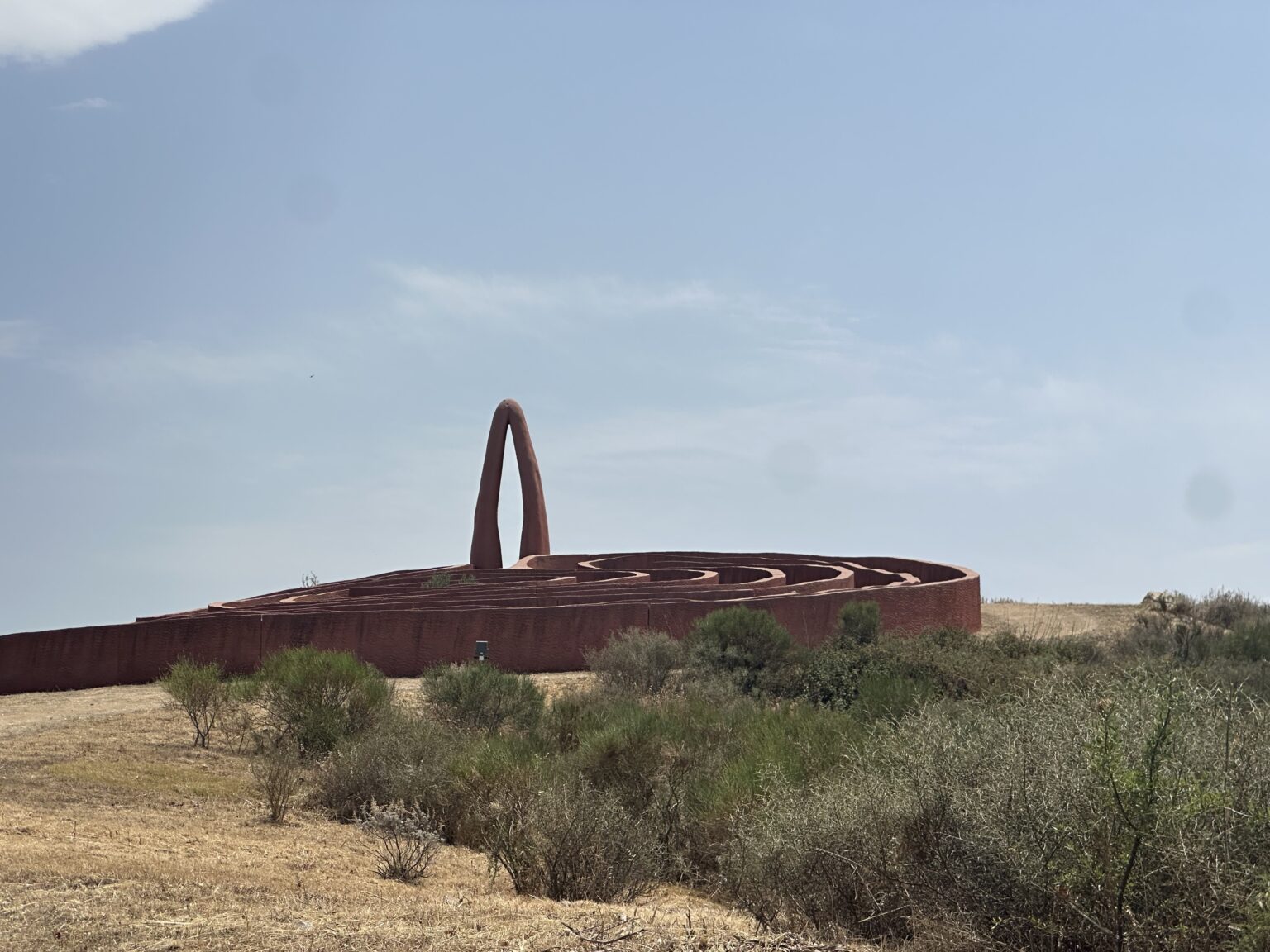
Of all the works in Fiumara d’Arte, Italo Lanfredini’s Labirinto di Arianna (Labyrinth of Ariadne) is the one that most explicitly invites visitors to participate.
Created in the late 1980s and located in the territory of Castel di Lucio, the labyrinth consists of a route designed to be walked through. It is not simply observed from the outside: visitors enter, move forward, change direction and search for the way to the centre.
The reference is to the Greek myth of Ariadne, the thread that enables Theseus to escape the Minotaur’s labyrinth, and the long symbolic tradition linking labyrinthine journeys to the search for oneself.
But you do not need to know every detail of the myth to understand the experience. You simply need to start walking.
A labyrinth forces you to give up, at least for a few minutes, the ability to see the whole route. You cannot survey the entire path from a single point: you must move forward, relying on your own choices. Every turn becomes a decision, every stretch a small experience of anticipation.
Lanfredini thus transforms an ancient motif into a contemporary work that brings body, space and thought into a relationship. The visitor is not a distant spectator but an active part of the artwork.
Tips for Experiencing the Labyrinth of Ariadne
Do not approach it as a race. Walk slowly, let the route determine the pace of your visit and, if you are travelling with someone else, consider walking through separately before comparing your impressions.
For children, it can be a particularly engaging experience, provided that access instructions and site conditions are respected. If the ground is wet, mobility is limited or accessibility is a concern, check the route conditions beforehand.
Castel di Lucio is also an opportunity to discover a village in the inland area of Messina, far removed from the coastal atmosphere. Continue your visit in the town centre, taking time to explore the streets and viewpoints that tell the story of the village.
Arethusa: Art That Becomes Part of Architecture
Castel di Lucio is also home to Arethusa, an intervention by Piero Dorazio and Graziano Marini created using polychrome ceramic panels applied to the architecture of the Carabinieri station.
The work is interesting because it moves away from the idea of sculpture as an independent object. Here, colour interacts with the building and with everyday life in the town.
The ceramic surfaces, through their combination of shapes and colours, introduce an artistic dimension into a functional building. The decoration is not simply an embellishment added afterwards; it becomes part of how the building is perceived.
It is an example of how the Fiumara d’Arte project gradually expanded its artistic language, including interventions that do not necessarily have the spectacular scale of its best-known works.
Since Arethusa is connected to a public service building, it is advisable to view it from outside, respecting the activities taking place there and not assuming that the interior is open to visitors.
Sixth Stop: Motta d’Affermo and the Blue Wave of Mediterranean Energy
With Antonio Di Palma’s Energia mediterranea (Mediterranean Energy), the landscape once again takes centre stage through an immediately recognisable shape: a monumental blue wave rising among the hills.
Created in 1989, the work is one of the most distinctive images associated with Fiumara d’Arte. Its colour evokes the sea, while its inland location creates a visual contrast that connects two essential elements of Sicily’s geography: mountains and water.
Blue is more than a colour choice. It evokes the Mediterranean, its light and its constant presence in the island’s imagination.
From a distance, the sculpture can look like a graphic mark laid across the landscape. As you approach, its structure becomes clearer and you begin to understand how the shape of a wave has been translated into a monumental construction.
The work’s particular strength lies in its apparent simplicity: a natural movement, normally unstable and destined to disappear, is fixed in architectural form.
The sea, which cannot be held in place, thus becomes a symbolic presence among the inland hills.
The Best Time to Visit Mediterranean Energy
If possible, visit on a clear day, when the light makes it easier to distinguish the blue sculpture from the surrounding landscape.
Do not overlook the panorama. Your visit should not be limited to finding the perfect angle for photographing the structure. Look at the hills, the mountain outlines and the direction in which the view opens up.
The area around Motta d’Affermo is one reason why Fiumara d’Arte is best explored by car. The distances between installations allow visitors to discover a landscape that is not a concentrated series of attractions but a collection of different environments linked by roads that form part of the experience.
Seventh Stop: The Pyramid of the 38th Parallel, the Symbol of Fiumara d’Arte
The Pyramid of the 38th Parallel, created by Mauro Staccioli and inaugurated in 2010, is probably the work that most strongly represents Fiumara d’Arte in the public imagination today.
The monumental corten steel structure stands on a hill in the territory of Motta d’Affermo, at a point where its relationship with the landscape and the horizon can be appreciated.
The title refers to a geographical coordinate: the thirty-eighth parallel north. In this way, a mathematical and seemingly abstract element becomes an integral part of the artwork’s meaning.
The pyramid is an ancient shape found in the imagery of many civilisations, associated with ascent, monumentality and the relationship between earth and sky. Staccioli reduces it to an essential geometric form, transforming it into a contemporary landmark emerging from the landscape.
The structure is hollow and has an opening through which its interior space can be perceived when access arrangements permit. It is not merely a volume to be viewed from a distance: its architecture creates a relationship between light, darkness and perception.
Corten steel, with its weathered, oxidised appearance, does not seek to blend completely into the environment. Instead, it makes the contrast between human intervention and nature visible, allowing both to retain their identities.
This is a work that deserves time. Look at it from a distance to understand its presence in the landscape, then approach to appreciate its scale and geometry. Photographs cannot fully convey the relationship between its dimensions, the surrounding space and the light.
The Rite of Light
The Pyramid is associated with the Rito della Luce (Rite of Light), a cultural and symbolic initiative connecting the artwork, light and collective reflection. The event has been linked to the summer solstice and to the search for a shared experience centred on beauty.
However, visitors should not assume that the interior is always accessible or that the event takes place every year in the same way. Anyone wishing to attend should check the official calendar, access arrangements and any booking requirements with the Antonio Presti Foundation.
For a regular visit, the advice is not to focus entirely on the possibility of entering the pyramid. Even from outside, the work offers a complete experience, especially if you observe how the structure changes with the light and your viewpoint.
Eighth Stop: Mistretta and the Mysterious Golden Boat Room
For those who want to explore the history of Fiumara d’Arte in greater depth, Mistretta is a particularly interesting stop. Situated inland in the Nebrodi area, the town has a close relationship with the mountain landscape and offers a chance to discover another side of northern Sicily, far from the coast.
Here you will find Stanza di barca d’oro (Golden Boat Room), a work by Hidetoshi Nagasawa created in 1989. It is one of the most enigmatic installations in the entire project, partly because it does not appear as a monumental sculpture immediately visible in the landscape.
The work was conceived as an underground space lined with steel plates and containing a stylised boat made of gilded brass. The contrast between the simplicity of the setting and the presence of the boat creates an image rich in suggestion.
The boat is an ancient symbol. It can evoke travel, crossing and the passage from one state to another. In Sicily, an island at the heart of the Mediterranean, this image has a particular resonance. For centuries, the sea has been a route of communication, but also a boundary, a promise and a place of separation.
Nagasawa translates these ideas into a work that does not rely on external spectacle but instead concentrates on space and the evocative power of a few elements.
One important detail for visitors planning their trip: the Golden Boat Room should not be regarded as an interior that can be visited freely. The space has been sealed and is not accessible to the public inside. Before including it as an actual stop, ask the Foundation to confirm the current arrangements for viewing the work.
Even when entering is not possible, its story enriches the meaning of the itinerary. Not all artworks are intended to be consumed through immediate visual impact. Some must be understood through their history, the imagination and an awareness of their access limitations.
Ninth Stop: Tusa and Matter Could Have Not Existed, the Work That Started It All
After travelling along the coast and through the hills, it is worth returning to Tusa to discover the artwork that gave rise to the entire project: La materia poteva non esserci (Matter Could Have Not Existed), created by Pietro Consagra and inaugurated in 1986.
It is an ideal place to conclude the itinerary because it brings the visitor back to the personal story from which Fiumara d’Arte emerged.
Antonio Presti had initially imagined a commemorative monument dedicated to his father. Consagra persuaded him to move beyond a traditional representation, choosing an abstract language capable of opening up an individual memory to a more universal reflection.
The work consists of two monumental concrete elements, characterised by contrasting colours and a relationship between solid forms and empty spaces that visually lightens their mass.
The title suggests a philosophical question: what would happen if matter did not exist? It is a question that invites visitors to reflect on the relationship between presence and absence, between what is concrete and what belongs to the imagination.
The sculpture is physically imposing, but it communicates through more than its size. The way the elements face each other and define a space between them encourages visitors to consider what has not been materially constructed.
Here, emptiness is not simply an absence. It is a fundamental part of the form.
The location of the work, connected to the landscape of the river valley, reinforces its meaning. Nature is not a neutral backdrop but an element with which the sculpture enters into dialogue.
Why Matter Could Have Not Existed Is an Essential Stop
Matter Could Have Not Existed tells the story of how a commemorative project became a collective cultural experience. Without this first work, Fiumara d’Arte would probably not exist in the form we know today.
For this reason, it is worth visiting even if you have already seen other monumental sculptures along the route. Here, the meaning of the entire project becomes clearer: art as a gift, beauty as a shared heritage and the possibility of enhancing a region through works capable of lasting over time.
A Work Not to Miss: The Wall of Life
Another work worth discovering is Il Muro della Vita (The Wall of Life), a collective intervention created in 1991 by forty ceramic artists from different European countries. The work is located in the territory of Mistretta and grew out of a project that used ceramics as a shared artistic language.
Its history is important because it reveals another aspect of Antonio Presti’s vision. Fiumara d’Arte is not simply the result of individual commissions awarded to prominent artists; it is also a space in which collaboration can become a form of creation.
Ceramics, a material deeply rooted in Mediterranean craft traditions, is used here in a contemporary composition. The work brings together different techniques and sensibilities, transforming part of the built environment into a support for artistic expression.
It is another reason not to limit your visit to the most photographed installations. Fiumara d’Arte gains meaning through the variety of its interventions: monuments standing alone in the landscape, artworks integrated into architecture and collective projects involving artists and local communities.
To reach the Wall of Life and check the best viewing point, consult an up-to-date map of the park and ask the Foundation for directions.
One-Day Itinerary or a Weekend Away?
The choice depends on how much time you have and the kind of experience you are looking for.
One-Day Itinerary: The Most Iconic Artworks
Focus on Castel di Tusa, the Window on the Sea, A Curve Thrown Behind Time, Mediterranean Energy, the Pyramid of the 38th Parallel and Matter Could Have Not Existed. Add the Labyrinth of Ariadne if travel times and access conditions allow.
This programme requires a full day and careful planning. Set off in the morning, check access points in advance and allow time for short stops at locations where parking may not be available close to the artworks.
Two-Day Itinerary: Art and Villages
Spend the first day exploring the coast, the Atelier sul Mare and the works accessible from Villa Margi. On the second day, discover Castel di Lucio, Pettineo, Motta d’Affermo and Mistretta, combining art stops with a leisurely lunch inland.
Staying overnight in the area allows you to experience the region at a slower pace and spend more time in the historic centres. The Atelier sul Mare may be an interesting choice for anyone who wants to turn their stay into an art-related experience, but availability, prices and visiting arrangements must be checked directly with the property.
Keep the programme flexible. The distance between two artworks is measured not only in kilometres but also in travel time along hilly roads and in the need to find a safe place to stop. Avoid trying to fit too many stops into one day.
Practical Information for Visiting Fiumara d’Arte
How to Get There
The area lies in the province of Messina, along the Tyrrhenian side of northern Sicily, between the coast and the inland Nebrodi region.
For visitors arriving by car from Palermo or Messina, the Tyrrhenian coast provides a useful reference point for reaching Castel di Tusa and Villa Margi. From there, continue inland towards the individual municipalities, following directions and the coordinates of the artworks.
Public transport can be useful for reaching some towns, but it is not the most convenient way to visit all the installations in a single day. Before travelling, check transport timetables and consider hiring a car if you do not have one.
How Much Does a Visit Cost?
Many of the artworks are outdoors, and the project is conceived as a public cultural resource. However, this does not mean that every space associated with the project is accessible without restrictions or that every experience is free.
Access arrangements for individual installations, the availability of guided tours and the conditions for visiting the Atelier sul Mare may vary. Overnight stays and special events may involve separate charges.
To avoid surprises, ask for information before setting off and do not assume that every artwork can be accessed freely at any time.
Can You Visit with Children?
Yes, the itinerary can be interesting for families. The Labyrinth of Ariadne is particularly good at stimulating curiosity, while the scale of the Window on the Sea and the Pyramid allows younger visitors to encounter artistic forms very different from those found in a traditional museum.
However, take into account the time spent travelling by car, exposure to the sun, uneven ground and the possible lack of facilities near some artworks. Bring water, hats and suitable footwear for outdoor stops.
Is the Route Accessible to Visitors with Reduced Mobility?
It is not possible to guarantee uniform accessibility across all the artworks. The sites are located in different settings, with varying ground conditions and approaches.
Anyone using a wheelchair or experiencing mobility difficulties should contact the organisers in advance to check the conditions at each stop and identify the sites that are easiest to reach.
When Is the Best Time to Visit?
Spring and autumn are generally the most pleasant seasons for visiting Fiumara d’Arte. Days can be bright without the intense heat experienced during some summer periods, and stops inland are often more comfortable.
In summer, set off early in the morning, especially if you want to visit several artworks. Bring water and protect yourself from the sun, as many installations are in exposed locations.
Winter can offer evocative atmospheres, but the weather, rain and condition of secondary roads must be taken into account.
What to Eat During the Itinerary
A trip to Fiumara d’Arte is also an opportunity to discover the cuisine of northern Messina and the Nebrodi area.
Along the coast, look for restaurants and trattorias serving fish. Inland, pay attention to products associated with local farming and pastoral traditions. Specialities from the wider Nebrodi area include Nebrodi black pork, local cheeses and dishes rooted in traditional country cooking.
Not every speciality is available in every village or in every season. Ask which products genuinely come from local farms and which dishes are prepared fresh that day.
Even a simple break at a village café can become part of the experience. Fiumara d’Arte invites visitors to discover a region through art, but it is the people, flavours and small everyday habits that complete the journey.
Why Fiumara d’Arte Is a Side of Sicily Worth Discovering
Fiumara d’Arte demonstrates that contemporary Sicily is not made up solely of ancient monuments, archaeological sites and monumental historic centres. It is also a region capable of embracing new artistic languages, experimenting with forms of patronage and developing cultural projects rooted in the community.
Antonio Presti’s story is central to this vision. The idea of transforming a family memory into an open-air museum gave rise to an experience involving artists, local authorities, residents and visitors. The long history of legal difficulties and the protection of the artworks also reminds us that cultural heritage does not preserve itself: it needs attention, maintenance and shared responsibility.
Visiting Fiumara d’Arte means travelling through a part of Sicily often left out of faster itineraries. It means discovering that an artwork may stand beside a country road, on a hilltop or in a small village, and that its relationship with that particular place can make it unforgettable.
The Window on the Sea teaches us to look at the horizon; the Labyrinth of Ariadne invites us to follow a path without immediately knowing where it leads; Mediterranean Energy brings the movement of the sea into the mountains; the Pyramid of the 38th Parallel connects geometry with landscape; and Matter Could Have Not Existed reminds us that emptiness itself can become a form of expression.
These are different experiences, united by the same idea: beauty can become a shared resource.
For anyone looking for an original itinerary in Sicily, away from the busiest destinations, Fiumara d’Arte is much more than a collection of sculptures. It is a journey between coast and inland, memory and contemporary life, artistic freedom and the richness of a region that still has so much to tell.