

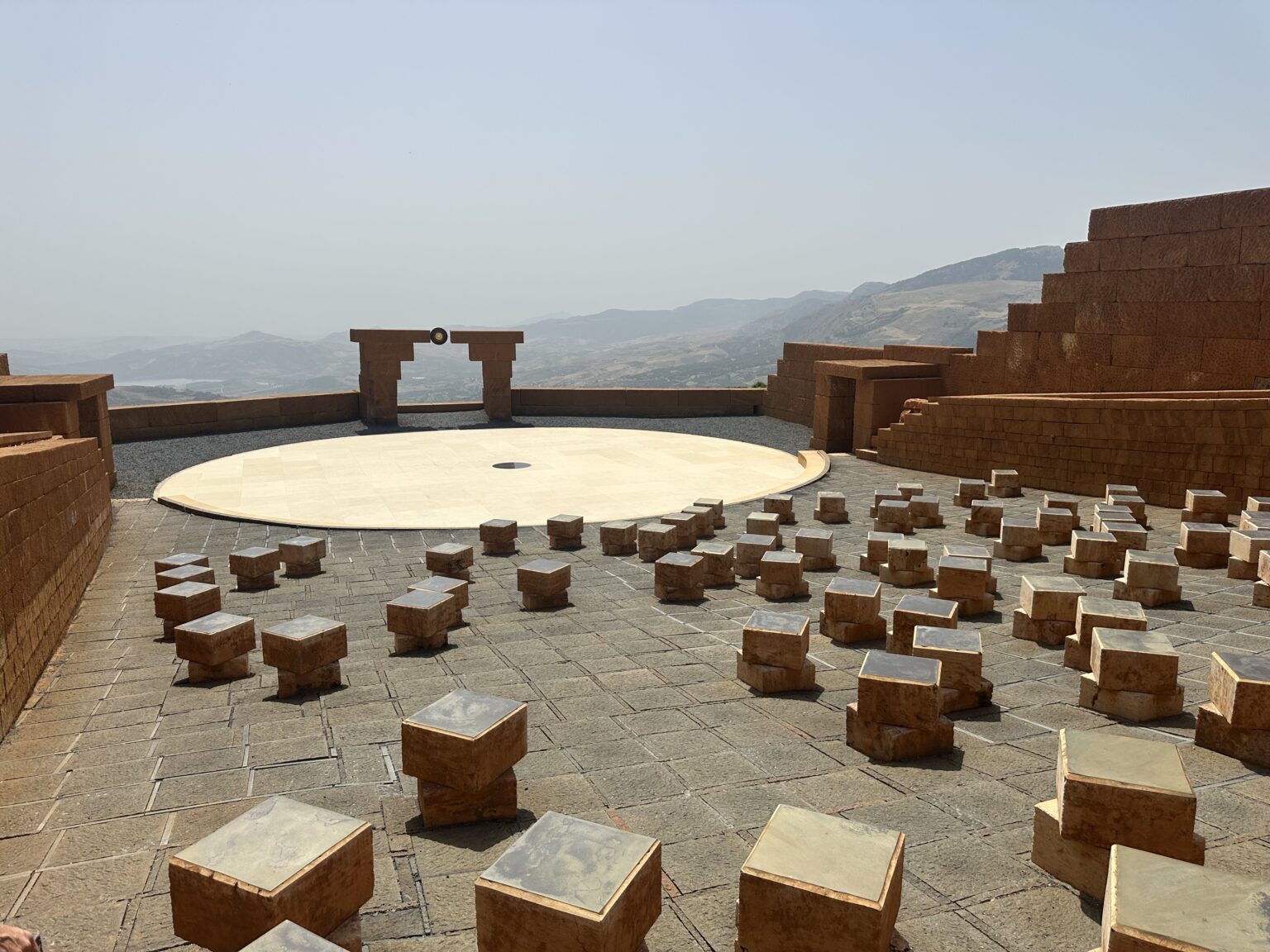


In the heart of the Sicani Mountains, in the province of Agrigento, stands a remarkable place where 108 blocks of stone connect with the sky and the surrounding landscape becomes part of a work of art. This is Teatro Andromeda, created from the vision of Lorenzo Reina, a sculptor and shepherd from Santo Stefano Quisquina. It is a fascinating story that leads to a lesser-known side of Sicily, among mountains, woodlands, ancient hermitages and small villages waiting to be discovered.
Some places are visited to admire a monument; others attract travellers because of their views. Then there are places like Teatro Andromeda, where architecture, nature and a deeply personal story come together in an experience that is difficult to capture in a photograph alone.
We are in Santo Stefano Quisquina, in the inland area of the province of Agrigento, where Sicily reveals a different face from the familiar beaches and celebrated historic cities. Here, among pastures, woodland and winding roads crossing the Sicani Mountains, one man imagined a theatre without walls, where the stage is not separated from the landscape and the sky seems to take part in the performance.
Teatro Andromeda is the result of the vision of Lorenzo Reina, an artist who grew up in the world of shepherding and developed a profound connection with his homeland. His work was not conceived as a conventional tourist attraction, but as a way of transforming his everyday relationship with the mountains into a creative project.
Today, the theatre is one of the most unusual destinations in inland Sicily. Yet reaching it also means discovering a story about work, imagination and perseverance, as well as a territory rich in places worth exploring: from the Hermitage of Santa Rosalia alla Quisquina to the historic centre of Santo Stefano Quisquina, including the surrounding woodlands and landscapes.
Lorenzo Reina: The Shepherd Who Dreamed of a Theatre in the Mountains
To understand Teatro Andromeda, we must begin with Lorenzo Reina and his relationship with Santo Stefano Quisquina. His artistic journey is closely connected to an environment where shepherding has long been an important part of the local economy and social history. It is a world shaped by the rhythms of nature, an intimate knowledge of the land and a direct relationship with the countryside.
Reina does not fit the traditional image of an artist working exclusively in an urban studio, far removed from open spaces. His creative path developed instead in close contact with the countryside and rural life. This familiarity with the landscape is essential to understanding his artistic research.
The mountains are not simply a setting in which to build a work of art. They provide the ideal environment for a project that seeks to connect human beings with something greater: the horizon, the sky, the passage of time and the vastness of nature.
Teatro Andromeda emerged from this intuition. It is neither an archaeological reconstruction nor an ancient Greek theatre rediscovered among ruins. Nor does it simply imitate a historic building. It is a contemporary work conceived to exist in close dialogue with its surroundings.
Its uniqueness also lies in the rural context in which the project took shape, far from the major cultural centres. This makes its story particularly compelling: an original artistic vision found its home in a part of Sicily that often remains outside the most popular tourist itineraries.
The theatre demonstrates that creativity does not belong exclusively to large cities or places already celebrated for their artistic heritage. It can also emerge from everyday life in an inland community, from its traditions and from a person’s relationship with the landscape in which they grew up.
For this reason, when visiting Teatro Andromeda, it is worth looking beyond the stone structure itself. The theatre also tells a story of possibility: how a seemingly remote place can become a cultural destination capable of attracting travellers, curious visitors and art enthusiasts.
Why Is It Called Teatro Andromeda?
The name Andromeda refers to the constellation of the same name. This is no minor detail, as the relationship between the earth and the sky is one of the central elements of the work.
The theatre’s seating area, known as the cavea, consists of 108 stone blocks arranged according to a precise geometric design inspired by the arrangement of stars in the Andromeda constellation.
The stones are tangible elements connected to the earth and the mountains. The constellation, by contrast, belongs to the realm of astronomy and the vastness of space. The theatre therefore brings two apparently distant dimensions together: the earthly world of rock and landscape, and the celestial world evoked by its name and the arrangement of the seats.
Geometry is not merely decorative. It helps define the identity of the place and encourages visitors to look at the work from a broader perspective.
The mythological reference is equally evocative. In Greek mythology, Andromeda is the figure associated with Perseus, part of a story that has endured for centuries and left its mark on the names of the constellations. In the Sicilian theatre, however, the reference to the stars serves primarily as a way of interpreting the work and its relationship with the universe.
You do not need to be an astronomy enthusiast to appreciate this connection. All you need to do is take a closer look at the arrangement of the stones, observe the horizon and imagine how the atmosphere changes as the light shifts throughout the day.
Rather than heading straight for the most photographed viewpoint, take a few minutes to observe the structure as a whole. The relationship between the seats, the ground and the surrounding landscape is an essential part of the experience.
A Theatre Without a Curtain, Where the Landscape Becomes the Stage
In a traditional theatre, the audience looks towards a stage framed by wings, backdrops and architectural structures. At Teatro Andromeda, the landscape itself becomes part of the visual composition.
The mountains, the sky and the changing light contribute directly to the experience. There is no clear separation between the artwork and its natural surroundings, because the project was conceived precisely to enhance this relationship.
The result is a space where architecture does not seek to dominate nature but instead guides the eye outwards. The stone structure provides a simple, essential framework, while the panorama changes according to the weather and the time of day.
This is what makes Teatro Andromeda appealing even to visitors who do not usually seek out contemporary art. The work can be appreciated through observation, silence and an awareness of space.
You should not expect an attraction filled with artificial special effects or a conventional museum route. The theatre’s charm lies in its simplicity. A visit calls for time, curiosity and a willingness to look carefully.
It is also a place where silence and respect matter. During a trip often filled with photographs, journeys and destinations to tick off a list, taking a few moments to pause may be the best way to understand the spirit of the work.
Teatro Andromeda and the Landscape of the Sicani Mountains
The theatre stands in Contrada Rocca, within the municipality of Santo Stefano Quisquina, in the Sicani Mountains. Its geographical setting is essential to understanding its identity.
This part of Sicily is characterised by hills and mountains, woodlands, pastures and small towns that maintain close ties with agriculture and shepherding. The landscape gradually changes from that of the coastal areas: roads wind through the hills, settlements are separated by wide stretches of countryside, and the journey becomes an opportunity to discover a less familiar side of Sicily.
Santo Stefano Quisquina is an excellent base for exploring this area. A visit to the theatre can be combined with a walk through the town centre, a trip to the Quisquina woodlands and a visit to the hermitage associated with the tradition of Saint Rosalia.
The natural environment offers something different in every season. Spring often brings vivid colours and lush vegetation; autumn creates warmer tones and beautiful light; summer is suitable for excursions, although protection from the sun is essential. During the colder months, visitors should take into account lower temperatures and potentially unfavourable weather conditions.
Before setting off, check the forecast and confirm that the theatre is open. Although Sicily is a Mediterranean island, its mountainous areas do not necessarily enjoy mild weather throughout the year. Wind, rain and temperatures can differ considerably from those along the coast.
The theatre is therefore a starting point for a broader journey: not simply a place to photograph, but a gateway to a mountainous part of Sicily that deserves to be explored at a slower pace.
How to Get to Teatro Andromeda
Teatro Andromeda is located in Contrada Rocca, in Santo Stefano Quisquina, in the province of Agrigento, Sicily. Travelling by car is generally the most convenient option, allowing you to plan your stops freely and explore nearby destinations.
The roads cross rural and mountainous areas, so drive carefully, observe speed limits and allow enough time for the final stretch of the journey.
Getting There from Palermo
From Palermo, take the Palermo–Agrigento expressway and follow the signs for Lercara Friddi. Once you reach the Filaga junction area, continue towards Santo Stefano Quisquina.
From there, pay attention to the signs for Teatro Andromeda and the junction indicated towards Castronovo, which leads to the site in Contrada Rocca.
It is advisable to enter Teatro Andromeda directly into your navigation app, check the suggested route and follow any local directions. Road conditions may change, so do not rely solely on a general description of the journey.
Getting There from Agrigento
From Agrigento, take the expressway towards Palermo and continue in the direction of the Lercara Friddi and Filaga area, following the route indicated by your navigation app.
The journey crosses part of the Agrigento hinterland, characterised by rolling hills and small towns. If you have a full day available, consider stopping in Santo Stefano Quisquina before or after visiting the theatre.
Getting There from Catania and Eastern Sicily
Visitors travelling from Catania can head towards Caltanissetta and continue along the road network towards Agrigento and Palermo, leaving the main route in the Lercara Friddi area. From there, follow the signs for Filaga and Santo Stefano Quisquina, then the directions to the theatre.
From Ragusa and south-eastern Sicily, the route may follow the SS 115 towards Agrigento before joining the roads leading towards Palermo. The exact itinerary depends on your starting point and current road conditions.
If you are travelling from far away, it is best to plan your visit without squeezing too many stops into a single day. The inland roads require attention, and the nearby attractions deserve time of their own.
Can You Reach Teatro Andromeda by Public Transport?
Reaching the theatre without a car requires more careful planning. Santo Stefano Quisquina is connected to other Sicilian towns by bus services, but you should not assume that a direct connection runs all the way to the theatre entrance.
Before travelling, check the available buses to the town, connections and return times. You will also need to arrange transport from the town centre to the theatre, taking into account the distance and the nature of the road.
If you do not have a car, ask local accommodation providers or tour operators whether they can arrange a transfer. Confirm availability, times and costs in advance, particularly if you also intend to visit the Hermitage of Santa Rosalia alla Quisquina.
Tickets, Opening Times and Practical Tips
Teatro Andromeda is a site with regulated admission. Before organising your trip, always check the latest information on the official website, as opening times, ticket prices and access arrangements may change.
The official website lists a single admission ticket at an indicative price of €10 per person. Online booking is available through the dedicated reservation platform. Before setting off, check the current price and the conditions applying to your chosen date.
For information and reservations, consult:
- Official website: www.teatroandromeda.it
- Booking platform: teatroandromeda.18tickets.it
- Telephone number published by the venue: +39 376 042 8723
The theatre is located in a natural environment, so wear clothing appropriate to the season. Even when temperatures are mild in the lowlands, the air at higher elevations can be cool and windy. Bring comfortable shoes, water and a light jacket, especially if you plan to spend a long time exploring the area.
Respect the site’s rules, keep noise to a minimum and do not leave litter behind. The venue’s published regulations prohibit smoking, eating and drinking within the theatre area, and the use of drones. Visitors travelling with pets should check the management’s current rules before their visit.
The municipality indicates that accessibility arrangements are available for visitors with disabilities. Anyone with specific requirements should nevertheless contact the venue in advance to ask about paths, gradients, distances and the actual access conditions.
When Is the Best Time to Visit Teatro Andromeda?
There is no single ideal time for everyone. Your choice will depend on the kind of experience you are looking for, the season and the weather.
Morning can be a good option for visitors who prefer generally cooler temperatures and want to spend the rest of the day exploring other destinations in the Sicani Mountains. An afternoon visit offers the opportunity to observe the landscape as the light changes, provided you respect the admission times and the venue’s instructions.
Sunset is often associated with the theatre’s most evocative photographs, but you should not assume that entry is permitted at any time or that you can remain beyond the authorised closing time. Always check the actual opening hours and plan your visit accordingly.
Spring and autumn are particularly appealing seasons for combining art and nature. In summer, bring water and protect yourself from the sun. In winter, check the weather and road conditions more carefully.
If you enjoy photography, take your time to observe the light and the proportions of the structure. You do not need to search exclusively for the most dramatic angle: the details of the stonework and the relationship between the theatre and the mountains can reveal just as much about the place.
What to See in Santo Stefano Quisquina: Take Time to Explore the Town
After visiting Teatro Andromeda, it is well worth heading into the centre of Santo Stefano Quisquina. The town is an important stop for understanding the local area and the context in which Lorenzo Reina’s project was created.
Rural life remains an important part of the town’s identity. Agriculture and shepherding have helped shape the surrounding landscape and the community’s traditions, while religious celebrations continue to play a significant role in local life.
A walk through the centre allows you to appreciate the streets, buildings and public spaces without the rush often associated with visits focused exclusively on major attractions. It is an ideal opportunity to stop at a café, ask residents for recommendations and enjoy the local cuisine.
The food traditions of the area reflect the agricultural and pastoral history of the Sicani Mountains. Cheeses, dairy products, meat dishes and specialities rooted in rural cooking are among the things to look for during a stop. To discover local produce, visit the shops and restaurants in town and ask which products are available in season.
There is no need to fill every minute of the day with planned activities. In a place like this, an unhurried stop can become an essential part of the journey, revealing aspects of local life that might otherwise go unnoticed.
The Hermitage of Santa Rosalia alla Quisquina: A Place of Silence and Memory
One of the most important stops to add to your itinerary is the Hermitage of Santa Rosalia alla Quisquina, nestled among oak trees in the territory of Santo Stefano Quisquina.
The site is associated with the tradition that Rosalia Sinibaldi, the young woman from Palermo who became Saint Rosalia, spent twelve years living in a cave on Mount Quisquina before moving to Mount Pellegrino in Palermo.
The story of Saint Rosalia brings together history, religious devotion and local tradition. Her withdrawal to a secluded place, far from worldly life, became part of the spiritual memory of this territory. The hermitage therefore has a significance that extends beyond its architectural value: it is one of the central places associated with devotion to the saint.
The complex includes the sanctuary and former monastic quarters, where visitors can learn about the lives of the hermits who inhabited the site. The museum route provides a glimpse into spaces such as the cells, kitchen and refectory, offering insight into the daily life of the religious community.
Particularly evocative is the cave associated with Rosalia’s presence. The contrast with Teatro Andromeda is striking: on one side, a contemporary artwork in dialogue with the sky; on the other, a place of contemplation connected with centuries of religious tradition.
A visit to the hermitage reveals another dimension of the Sicani Mountains, where the relationship with nature is expressed through silence, reflection and devotion.
Before setting off, check the opening times of both the sanctuary and the museum route, as they may differ. Accessibility also varies across the complex, so visitors with mobility difficulties should seek information in advance.
The Quisquina Woods: Discover Sicily’s Green Side
The Quisquina Woods are another destination worth considering if you want to spend more time in nature. The woodland surrounding the hermitage is one of the area’s most characteristic environments and offers an alternative to days spent exclusively among monuments and town centres.
Here, the pace of the journey changes. The landscape invites you to walk, observe the trees and listen to the sounds of the natural environment, allowing you to enjoy an experience that is less focused on reaching a particular viewpoint.
The woods are particularly appealing to those who enjoy hiking and want to discover the natural heritage of inland Sicily. Before setting out on a trail, however, find out about its length, elevation gain, ground conditions and the availability of trail markings.
Not every path is suitable for every visitor, and a destination’s proximity does not necessarily mean it is easy to reach on foot. Appropriate footwear, water and up-to-date information are essential, especially during hot weather or after periods of rain.
The woods and the hermitage can be visited on the same day as Teatro Andromeda, but it is best to check opening times and assess the distances in advance. If you also want to explore the centre of Santo Stefano Quisquina, allow a full day rather than planning a quick excursion.
Monte San Calogero and the Landscapes Around the Town
Visitors who wish to explore further will find other places connected with religious history and the geography of the Sicani Mountains. One worth considering is Monte San Calogero, associated with the church dedicated to the saint and listed among the municipality’s places of interest.
The presence of religious sites scattered throughout the area tells an ancient story of the relationship between communities, landscape and spirituality. Churches and sanctuaries were not simply places of worship: in many cases, they also served as landmarks for rural communities and for people travelling through the mountains.
Before visiting Monte San Calogero, check the precise location of the site you intend to see, the road conditions and whether part of the route must be covered on foot. Avoid taking unplanned detours along unfamiliar rural roads, particularly if you are travelling in a single vehicle.
Photography enthusiasts may also enjoy the views along the roads connecting Santo Stefano Quisquina with neighbouring towns. The inland landscape offers scenes in which fields, pastures and mountain slopes change their appearance with the seasons and the light.
The Itinerarium Rosaliae: Following a Saint Through Inland Sicily
If you want to turn your visit into a longer journey, Santo Stefano Quisquina is also a stop along the Itinerarium Rosaliae, a walking route linking places associated with the life of Saint Rosalia across the provinces of Palermo and Agrigento.
The route extends for approximately 178 kilometres and crosses a network of trails, old rural roads, mule tracks and other paths. It connects the Sanctuary of Monte Pellegrino in Palermo with the Hermitage of Santa Rosalia alla Quisquina, passing through several towns in inland Sicily.
This is not simply a short walk to add casually to a visit to the theatre. It is an extensive route designed for those interested in hiking and pilgrimage, with stages that must be planned according to individual fitness and experience.
If you only have one day available, you can visit the hermitage and enjoy a walk in the surrounding area without attempting the entire route. Those interested in the full trail should consult the municipality’s official channels and the resources dedicated to the Itinerarium Rosaliae, checking the latest information about trail conditions.
The connection between the hermitage and the walking route adds another dimension to the area. The journey is not only about beautiful landscapes, but also about the history of local communities, religious traditions and the ways in which certain places have become important landmarks over the centuries.
A One-Day Itinerary Combining Art, Woodland and Spirituality
To visit Teatro Andromeda and explore the surrounding area without rushing, consider planning a day around three different experiences: contemporary art, religious heritage and the natural landscape.
You can begin the morning at Teatro Andromeda, checking the admission times and booking in advance if necessary. Allow enough time to appreciate the structure and the panorama rather than treating the visit as a quick photo stop.
Afterwards, head to Santo Stefano Quisquina for a walk through the town centre and a lunch break. Tasting local products is a practical way to discover the area’s identity while supporting local businesses.
The afternoon can be devoted to the Hermitage of Santa Rosalia alla Quisquina and the surrounding woodland, depending on opening times and the time available. If you enjoy walking, choose a trail suited to your abilities and check the conditions before setting out.
This itinerary is only a suggestion: you can change the order of the stops according to opening times, the season and the weather. Check official information before travelling and allow enough time to move between destinations.
If you have an entire weekend, you can slow down, stay overnight in the area and spend more time exploring the villages and landscapes of the Sicani Mountains. This avoids turning every visit into a race against the clock and leaves room for spontaneous stops.
What to Bring and How to Prepare for Your Visit
Teatro Andromeda is an outdoor destination, so what you need to bring will depend mainly on the season and the activities you have planned.
- Comfortable shoes: useful for exploring the site and taking walks in the surrounding area.
- A jacket: wind and temperatures at higher elevations can differ from conditions along the coast.
- Water: particularly important during the warmer months and if you plan to hike.
- Sun protection: useful on sunny days, even when the air feels cool.
- A fully charged phone: helpful for navigation and checking visitor information.
- Booking confirmation and opening times: check the official website before setting off.
If you are travelling with children, consider the length of the visit and explain that the theatre is a place to be treated with respect. Children should not climb on the structures and must follow the venue’s instructions.
Visitors with accessibility requirements should contact the venue directly. General information cannot replace specific details about paths, distances and the services available on the day of the visit.
Why Teatro Andromeda Deserves a Place on Your Sicilian Itinerary
Teatro Andromeda stands out because it brings together contemporary art, a personal story and the natural landscape without relying on a single spectacular feature.
Its appeal lies not only in the shape of its stone seats or the views of the mountains. It also lies in the story of Lorenzo Reina, his connection with rural life and his decision to create a work that engages with a territory far removed from the main tourist circuits.
A visit reveals a side of Sicily different from the one found on the most familiar postcards. This is a Sicily of mountains and woodlands, towns where traditions remain visible and destinations that reward travellers who plan carefully and take their time.
Combining the theatre with the Hermitage of Santa Rosalia alla Quisquina makes the experience even more rewarding. The theatre tells the story of a contemporary artist’s vision, while the hermitage evokes a religious tradition stretching back through the centuries. In different ways, both demonstrate how the landscape can shape the relationship between people and the places where they live.
Hiking enthusiasts can add a walk through the Quisquina Woods. Culture lovers can spend more time in the town and exploring the story of Saint Rosalia. Those simply looking for a break from their daily routine can enjoy a few hours in a mountainous environment, far from city traffic and the pace of urban life.
Teatro Andromeda: Discover Sicily Through Different Eyes
The story of Teatro Andromeda begins with an artistic vision rooted in shepherding and takes shape in a place where stone meets the sky. Its 108 seats, the geometry inspired by the constellation and the surrounding landscape of the Sicani Mountains create a work that invites visitors to look beyond appearances.
Yet the journey does not end when you leave the theatre. Santo Stefano Quisquina, the Hermitage of Santa Rosalia, the Quisquina Woods and the routes associated with the Itinerarium Rosaliae reveal a territory rich in stories, traditions and natural environments.
This is the value of travelling through inland Sicily: discovering that, far from the best-known destinations, there are places capable of surprising visitors and offering a different idea of travel. One that is not necessarily about covering great distances or collecting attractions, but about connecting with the landscape, culture and people who have given shape to their own ideas.
Teatro Andromeda is a compelling reason to visit Santo Stefano Quisquina. The Sicani Mountains are a reason to stay longer.
USEFUL INFORMATION
Location: Teatro Andromeda, Contrada Rocca, Santo Stefano Quisquina, province of Agrigento, Sicily, Italy.
How to get there: By car, following directions towards Lercara Friddi, Filaga and Santo Stefano Quisquina, then the signs for Teatro Andromeda. Check the latest route information before setting off.
Admission: The published indicative price is €10 per person. Check the official website for current prices and access arrangements.
Bookings and information: www.teatroandromeda.it
Places to combine with your visit: Santo Stefano Quisquina town centre, the Hermitage of Santa Rosalia alla Quisquina, the Quisquina Woods and the nature trails of the Sicani Mountains.
Travel tip: Allow at least one full day for the area, check the opening times of the different attractions and book your theatre visit before setting off.
SEO keywords: Teatro Andromeda, Teatro Andromeda Santo Stefano Quisquina, Lorenzo Reina, things to do in Santo Stefano Quisquina, how to get to Teatro Andromeda, Hermitage of Santa Rosalia alla Quisquina, Sicani Mountains, Sicily travel.